How Can the Supreme Court Overturn Legislation Approved by the Congress and the President?
F rom 1979 until her retirement in 1998, Lilly Ledbetter worked at Goodyear Tire and Rubber's plant in Gadsden, Alabama. Once she had left the job, she learned a disturbing fact. When Ledbetter had started, her supervisor salary was comparable to men in like positions. Only with each functioning review, the men she worked alongside got bigger raises, and she gradually roughshod farther and further behind. Past the time she retired, she was earning $3,727 a month: hundreds of dollars less than the lowest-paid man in her position, and significantly below the average man.
Ledbetter took Goodyear to court, alleging a breathy violation of Title VII of the Ceremonious Rights Act, which guarantees equal treatment in the workplace. But in 2007, the Supreme Court held that the statute of limitations on her claims had expired, and she could no longer seek redress. She would have had to file her claim shortly later on Goodyear hired her, the court ruled. This was an cool request — Ledbetter didn't know how she was being cheated until she neared retirement — and it served to gut the ability of whatsoever woman to reasonably enforce the law.
The Supreme Courtroom had issued what'due south known as a statutory ruling, which is distinct from a constitutional ruling. In other words, the courtroom had non deemed the constabulary itself to be unconstitutional merely simply ruled that the way the statute had been written rendered it unavailable to Ledbetter.
Supreme Courtroom Justice Ruth Bader Ginsburg wrote a dissent that urged Congress to arbitrate. The courtroom's interpretation, Ginsburg said, was out of step with mod wage bigotry and the realities of the workplace. She recommended Congress amend the police force and fix the court'south "parsimonious reading" so workers like Ledbetter could have a shot at restitution. Ginsburg added: "The ball is in Congress' court."
Ledbetter became a proxy for the cause of equal pay for equal work, and Democrats pledged to fight the ruling the first take a chance they got. And they did, rewriting the statute so that the clock would start ticking on the statute of limitations each fourth dimension a discriminatory paycheck was issued, not at the fourth dimension an employee was beginning hired. The very first piece of legislation President Barack Obama signed in 2009 was the Lilly Ledbetter Off-white Pay Act.
What makes Ledbetter so unusual is that Democrats have non similarly fought equally cool all the same consequential rulings from the Supreme Courtroom, instead throwing their hands up in despair at the unfairness of a particular decision and then moving on.
Simply a joint review of dozens of Supreme Court cases by The Intercept and the American Prospect finds dozens of statutory rulings similar to Ledbetter's that Congress could overturn but by tweaking the statute to remove whatsoever ambiguity the court claimed to discover in its text. Fifty-fifty where the court has ruled on constitutional grounds, there is ofttimes much room left to legislate the boundaries, but as conservatives accept done in relation to Roe 5. Wade and abortion restrictions. From salvaging the Voting Rights Deed gutted past Shelby Canton v. Holder in 2022 to protecting workers' free speech rights on the job or safeguarding reproductive rights, the list of cases awaiting a artistic Congress runs long.
Overrides tin be passed on an individual basis, every bit office of larger omnibus bills, or even tacked on to unrelated appropriations or debt ceiling bills. Even the Affordable Care Deed, which is currently under judicial review nevertheless again, could be rescued from the court'south clutches with a simple legislative tweak. Well-nigh of the legislation necessary to overturn these decisions is brusque: just a few lines to reinforce congressional intent in a way that the judiciary cannot distort it.
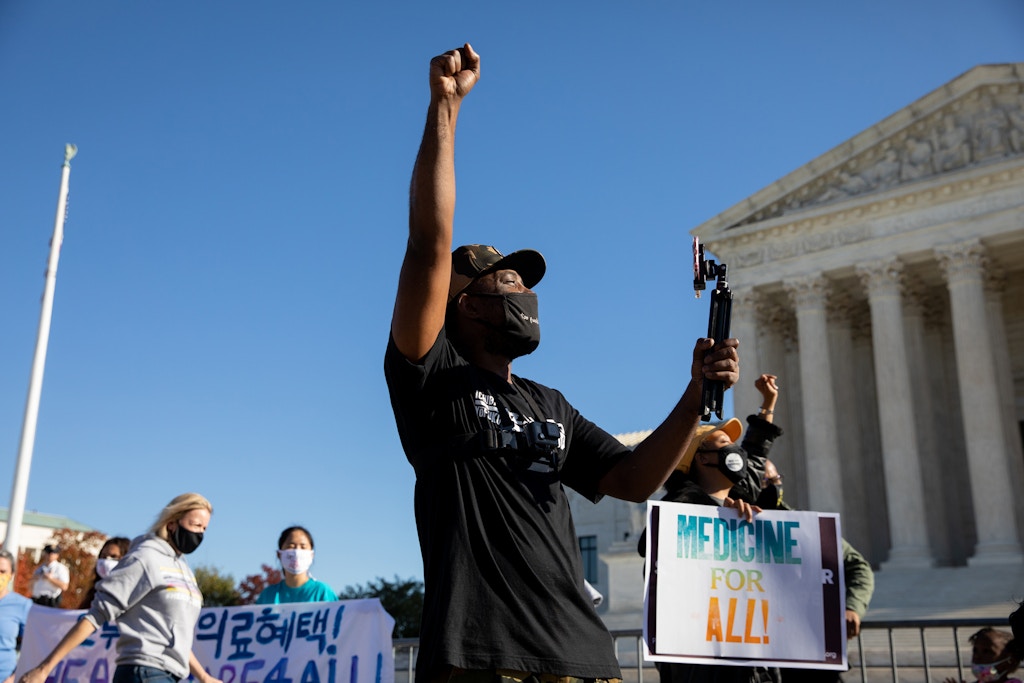
Photo: Amanda Andrade-Rhoades/Bloomberg via Getty Images
These statutory overrides offer a road map for progressives left paralyzed by the court's new composition, with the installation of Amy Coney Barrett every bit a sixth conservative justice. Congress can place an important and ever-needed check from a co-equal branch on an increasingly conservative judiciary, which has non shied from defanging legislation, especially regulatory police. Just equally the court sets the boundaries of congressional intent, Congress can movement those boundaries.
Since the death of Ginsburg in September, the left has debated various options for reforming what many see as an overly partisan judiciary. Some accept called for increasing the number of justices to help restore the court's ideological balance. Others have suggested term limits, or requiring a supermajority for sure decisions. In mid-October, and so-presidential candidate Joe Biden said that if elected, he would convene a bipartisan grouping of scholars to make recommendations on court reform.
While changing the rules and the makeup of the judiciary holds hope, demoralized activists should not lose sight of Congress's ability to temper or reverse existing courtroom decisions. Statutory overrides and chipping abroad at conservative constitutional decisions should be role of any future progressive agenda, and the gear up of demands brought to negotiations past the White Firm and Democrat-controlled Firm of Representatives.
Only as the courtroom sets the boundaries of congressional intent, Congress can motility those boundaries.
Overriding judicial decisions, while always an important tool in Congress'due south legislative toolbox, has fallen by the wayside over the concluding 2 decades. 1 study, by Yale law professor William Eskridge Jr. and then-federal police force clerk Matthew Christiansen, traces the turning point in the nation's history of judicial overrides to the mid-1970s, when emboldened post-Watergate Democrats passed major omnibus legislation (similar the Tax Reform Human action of 1976) that updated laws and rejected various Supreme Court decisions at in one case. It helped that this new wave of overrides overlapped with large increases in congressional staff; House committee staff increased by two-thirds betwixt 1973 and 1975, and the House and Senate judiciary committees grew by fifty-fifty more.
For the next 20 years, upward until 1998, Eskridge and Christiansen establish that the Democratic-controlled Congress was "energized, aggressive, and highly … interventionist in matters of state policy" and therefore "happy to denounce and reverse anti-regulatory" judicial rulings. Popular policy areas targeted for judicial overrides included civil rights, federal jurisdiction, and tax police, but were not limited to those. Even in the polarized decade of the 1990s, Congress overrode more than than 80 rulings, more any in the preceding four decades. But following Clinton's impeachment in 1998, judicial overrides slowed to a trickle.
Federal lawmakers currently take something of a piecemeal arroyo to judicial overrides. Several recent bills that have passed the House override Supreme Court decisions as part of more comprehensive larger legislation, like the Protecting the Right to Organize Human action and the For the People Deed. But Congress has yet to take up the curtain of congressional overrides as an organized, concerted strategy to take back ability.
Some observers, like Academy of California, Irvine constabulary professor Rick Hasen, predict that judicial overrides would likely crave near-unified control of Congress and the presidency, like Democrats had in 2009 when they passed the Lilly Ledbetter Human action. In other words, whether Democrats retake the Senate post-obit two Georgia runoffs in January could take a major impact on their ability to get judicial overrides through the legislative grinder, especially as many areas of in one case bipartisan lawmaking, particularly civil rights, have grown more polarized.
All the same, despite Congress's hyperpartisanship, there may be some opportunity for lawmakers to take activity on judicial overrides where there's bipartisan understanding. Moreover, fifty-fifty if Democrats can't push multiple judicial overrides as standalone legislation, lawmakers could try to tack fixes onto must-pass legislation like the annual National Defense Authorization Act. (These bills — known in congressional jargon as "riders" — are common ways lawmakers leverage the appropriations process to button pet projects through each twelvemonth.)
Federal lawmakers have for too long accepted the rulings of the Supreme Court every bit intractable, when they have the power to answer in many cases.
Some of this is about finding the correct window of opportunity, only a not bad deal is about refocusing the minds of federal lawmakers, who accept for besides long accepted the rulings of the Supreme Court every bit intractable, when they have the power to respond in many cases. "The energy has but not e'er been there," said Charlotte Garden, a professor at the Seattle University School of Law who specializes in labor and employment law. Congress should be reinvigorated to utilize its power, and not simply sit down back in resignation.
For lasting progressive change, history shows the states that only passing a judicial override won't exist enough. Indiana University Maurer School of Law professor Deborah Widiss found that legal research services like Westlaw and LexisNexis exercise not reliably observe congressional overrides, especially if lawmakers do not explicitly identify in the law which case their new statute overturns. Advocacy groups will demand to vigorously educate attorneys and judges about them, or the overrides could go ignored for years by the courts. "You might assume that all yous have to do is change the law, just my research suggests courts don't ever implement even really prominent overrides," Widiss says, pointing to the ADA Amendments Human action of 2008, which updated the Americans with Disabilities Act of 1990.
While the future of judicial reform is hazy, holding courts answerable to changes is a claiming that lawmakers and activists, working together, can meet. Past zeroing in on statutory decisions, Congress tin reclaim its power, and advance change for millions. Here are several areas where progress can be made.
one Reproductive Rights

Illustration: Michael Haddad for The Intercept
While current legislative momentum for reproductive rights is focused on overturning the Hyde Subpoena — a federal provision that since 1976 has barred Medicaid funding for abortion services — and the long-term desire to codify Roe v. Wade into legislation, there are other statutory measures lawmakers could accept to strengthen reproductive rights.
I way is past clarifying that the 1993 Religious Liberty Restoration Act — the statute that was at the heart of the Burwell v. Hobby Lobby example in 2022 — cannot be used as a tool of bigotry. RFRA was itself a statutory response to a poor 1990 decision that many groups felt weakened religious freedom, peculiarly for religious minorities. But advocates say RFRA has been twisted and abused over the final decade, assuasive non only organizations to deny contraception coverage to their employees only also to burn down transgender workers, likewise as enabling federally funded kid welfare providers to deny potential foster or adoptive parents deemed the "wrong" religion. In the Hobby Lobby conclusion, five justices concluded that RFRA permits for-profit companies to deny contraception coverage to employees based on a religious objection.
To fix all this, Congress could quickly laissez passer the Do No Harm Deed, an existing bill backed by several civil and reproductive rights groups which would clarify that RFRA is meant to protect religious freedom without allowing damage inflicted onto others, such as denying groups contraception. It was introduced in the House in 2022 by Autonomous Reps. Joe Kennedy and Bobby Scott, and in the Senate past Sen. Kamala Harris, the vice president-elect. To engagement, it has 215 Business firm and 31 Senate co-sponsors.
Brigitte Amiri, a deputy director at the American Civil Liberties Matrimony'south Reproductive Liberty Project, said the Do No Harm Act would be a "more robust" way to get at cases like Hobby Lobby because it would bar RFRA lawsuits if they discriminate confronting third parties.
2 Ceremonious Rights
Voting Rights

Analogy: Michael Haddad for The Intercept
Perhaps the almost consequential legislation passed in the 20th century lost its authorization in a Supreme Court ruling decided on statutory grounds. In Shelby Canton five. Holder (2013), the courtroom held in a party-line, 5-four vote that Department 4(b) of the 1965 Voting Rights Act, which required jurisdictions with histories of discrimination to go federal preclearance earlier changing voting laws, put untenable burdens on states, because the conditions at the time of the legislation are no longer true.
The decision was a disaster for voting rights advocates. In the aftermath, dozens of states implemented voter ID laws, including a N Carolina police that a federal court said discriminates against Black voters "with virtually surgical precision." The Leadership Conference on Ceremonious and Human Rights documented that between 2022 and 2018, more than 1,600 polling places were closed. One of the most breathy flourishes of this renewed ability to curtail voting rights was Georgia Gov. Brian Kemp'southward gubernatorial campaign. While secretary of land, Kemp oversaw the removal of 1.5 meg voters from the rolls, likewise as another 500,000 during his campaign for governor.
Courts have found at to the lowest degree 10 instances of intentional discrimination in voting rights decisions since Shelby Canton five. Holder, a directly counter to Chief Justice John Roberts'south majority opinion that conditions in 1965 no longer be.
Like in the Ledbetter decision, the minority dissent made clear that an updated preclearance formula — which the courtroom called unconstitutional — tin and should exist designed by Congress. The John R. Lewis Voting Rights Act of 2020, which overrides the Shelby ruling, among other voting rights protections, has already passed the Business firm. The nib would update the statutory language for preclearance, too as add new voter protections.

House Majority Whip James Clyburn, D-South.C., speaks at a press conference on Capitol Hill as Firm Democrats mark the anniversary of Shelby County 5. Holder and urge the Senate to pass H.R. 4, the Voting Rights Advocacy Act, on June 26, 2020.
Photo: Tasos Katopodis/Getty Images
Democrats' first beak of the 116th Congress was the For the People Act of 2019, legislation that expands voter protections; ratchets upward ethics standards for executive co-operative officials, members of Congress, and Supreme Court justices; and provides for new campaign finance rules. It as well addresses another voting rights case that can exist overturned through a congressional override, Husted v. A. Philip Randolph Institute (2018), which ruled that Ohio's voter purges were legal.
If a voter in Ohio hasn't voted in two years, they receive a card in the post; if they don't return it, and do not vote in the next four years, the voter is kicked off the rolls. Voter advocates declared that the policy violated the National Voter Registration Act of 1993, which explicitly bars states from removing someone on the basis of not voting. But the courtroom decided that the law does not violate the NVRA because the failure to vote is not the only reason for removal: Ohio's law also requires that the voter not respond to the mailed notice. The voter purges unduly touch on Blackness voters, especially in Ohio'south three largest metro areas, which are besides Autonomous-leaning. The For the People Human activity specifically overrides the Husted decision by making voter purge schemes like Ohio's illegal nether the NVRA.
The bill also tackles another courtroom decision, Citizens United v. FEC (2010), which famously prohibited the federal regime from restricting political expenditures past corporations under the Commencement Amendment. Because the decision was on constitutional grounds, Congress can't overturn it simply by updating the law, and a ramble amendment remains unlikely. But the new legislation seeks to temper its force through public financing, requiring more transparency, and restructuring the Federal Election Committee.
"Congress can have a real dialogue with the court, even when the Supreme Court strikes down a constabulary Congress has passed equally unconstitutional," said Daniel Weiner, deputy director of the Brennan Center's Ballot Reform Program. The strategy is not unlike from how the right reacted to Roe 5. Wade, chipping abroad at the decision over time, he said. "If the other side doesn't treat Supreme Court decisions as final, and continues to look for ways to accomplish its goals, I certainly retrieve progressives should do that as well."
Disability Rights
Despite a bipartisan congressional disability rights caucus with over 50 House members, lilliputian energy has been put forth to proactively curlicue back statutory decisions that harm individuals with disabilities.

Illustration: Michael Haddad for The Intercept
The most consequential example that Congress could address would be Buckhannon Lath and Care Dwelling house 5. West Virginia Section of Wellness and Human Resources, a 2001 decision which has fundamentally distorted civil rights litigation over the last two decades. In that 5-4 decision authored by Chief Justice William Rehnquist, the court effectively rendered moot the possibility for a lawyer to collect chaser's fees if a defendant corrects the issue before the example is completed.
The conclusion "has meant that far fewer civil rights lawyers have inability cases, since they know there'south a high hazard they won't get paid," said Sam Bagenstos, a law professor at the University of Michigan who has argued 4 cases before the court.
To ready Buckhannon, Congress would need to clarify the so-chosen catalyst theory, a rule courts used to rely on that says if a plaintiff's lawsuit was the goad for a change that benefited the plaintiff, the plaintiff would exist treated every bit having prevailed even if the plaintiff didn't have to litigate all the manner to a last judgment.
"I retrieve you lot could write a statute that gives attorney fees to an attorney who makes a demand letter of the alphabet to a defendant that says, 'Look I'm going to sue you unless you brand these changes,'" Bagenstos said. "It's not similar the plaintiff lawyer would get some large windfall but it would ensure they get paid evenly for the fourth dimension spent on the case to that betoken." The Civil Rights Human activity of 2008 included a measure to overturn Buckhannon, but policymakers at the time were more than focused on the economy and health care. A new Congress could revive it.
Congress could also make it easier for lower-income families to seek redress nether the Individuals with Disabilities Education Act past effectively repealing Arlington Central Schoolhouse Commune Board of Education v. Murphy. In that 2006 case, the court ruled that expert witness fees were not compensable under the act, meaning families who wanted to bring in expert testimony would demand to pay for it out of pocket. The Arlington Centraldecision also disincentivized lawyers from taking cases for families who wouldn't be able to bring in the kind of evidence necessary to win.
"At that place are notorious class divides in IDEA cases," said Bagenstos. "Upper-middle form and heart class parents exercise far, far meliorate, and a lot of the issues really exercise crave an proficient witness to help families effectively press their case."
Congress could likewise clarify that the burden of proof in IDEA cases rests on schools, not parents, which would be a reversal of the court'south 2005 decision in Schaffer v. Weast. "Information technology's hard to go people excited about burden of proof considering they don't understand it, simply there's no question that putting the burden of proof on the plaintiff every bit opposed to the schools makes it harder for families to enforce their rights," said Chris Edmunds, a disability rights attorney.
Sasha Samberg-Champion, another inability rights chaser, said Congress should wait at lower-court decisions too, since advocates accept largely avoided bringing new disability cases over the final decade to what they view as a hostile judiciary. For example, Congress could clarify that the statute of limitations for an Americans with Disabilities Act case starts from the time someone with a disability is discriminated against past an inaccessible facility, not the time when the inaccessible facility was outset constructed — an issue similar to the one Congress addressed with the Lilly Ledbetter Act. Congress could as well confirm that the ADA covers online-just businesses.
"It used to be that if we got a bad Circuit court decision we could file for Supreme Court review, just nosotros don't dare do that at present since nosotros'd chance only making things worse," Samberg-Champion said. "That makes information technology even more than important for Congress to step in and provide relief where the Supreme Courtroom won't."
3 Environment

Illustration: Michael Haddad for The Intercept
Dissimilar other areas, ecology constabulary largely rests on legislation passed fifty years agone during the Nixon assistants. In the subsequent years, conservatives have carved out exceptions to protect their environmental interests from the judiciary — such as with laws effectually endangered species. At present, every bit federal agencies strain to see new and growing challenges like climatic change, Democrats should push for updates to those statutes.
Although experts say comprehensive legislation is preferable to statutory overrides, Congress could strengthen climate modify regulations past clarifying that greenhouse gases are air pollutants covered under the Clean Air Human activity. That would overturn Utility Air Regulatory Group five. Environmental Protection Agency (2014), which said that the EPA had overstepped its authority by regulating greenhouse gas emissions from new motor vehicles. An earlier case, Massachusetts 5. EPA (2007), determined that air pollution included carbon emissions. But without clarifying language in the statute, carbon reduction policies are effectively field of study to a conservative court.
The Make clean H2o Human action also desperately needs clarification: The law regulates "the waters of the United States" but doesn't specify which waters. In 1 prominent case, Rapanos five. United States in 2006, the court immune for an "expansive" interpretation of the Clean H2o Act but left "waters of the United States" undefined. Defining which waters are included would preserve important ecosystems and improve protect the public.

Signs mark the route of the Atlantic Declension Pipeline in Deerfield, Va., on Feb. viii, 2018.
Photo: Steve Helber/AP
A decision this year, U.S. Forest Service five. Cowpasture River Preservation Assn., enabled the Atlantic Coast Pipeline to crisscross the Appalachian Trail twice by sidestepping the Mineral Leasing Act, which allows the U.S. Woods Service to grant permits to pipeline companies. The decision allowed the Forest Service's attain to extend into the Appalachian Trail, for which the National Park Service is technically responsible only which traverses national woods. A quick legislative fix could clarify that the trail is protected NPS land, and thus not subject to Mineral Leasing Act permits. Only D.J. Gerken, pb counsel for Cowpasture River Preservation Clan, too said Congress could go further by alteration the Mineral Leasing Act and requiring pipeline companies to testify that the best possible route is through federal lands.
Under the Clean Water Act, the EPA regulates water pollutants that go into waters, similar a pipe discharging into a lake, and the Army Corps of Engineers regulates filling in wetlands, such every bit a developer with a bulldozer. To better protect the environment, Congress could update the statute to require mining companies obtain permits from both agencies, to avoid a echo of the court's decision in Coeur Alaska, Inc. five. Southeast Alaska Conservation Quango (2009).
Trying to graft environmental rules on decades-onetime policies has proven difficult. In EPA v. EME Homer Metropolis Generation (2014), the court upheld the EPA's 2022 send rule, which regulated cross-country air pollution from upwind states to downwind states, every bit required nether the Clean Air Human action. But the instance left the EPA with a flawed regulation programme. Ann Carlson, ecology law professor at the University of California, Los Angeles, said that advocates have sought a cap-and-merchandise program to regulate cross-state air pollution, which would be cheaper and more cost-effective than regulating individual plants. "Only the statutory language is actually brusque and unclear, so it would be super helpful to have a statutory fix," she said.
Other cases are relatively straightforward. In Michigan five. EPA (2015), the courtroom ruled that the agency must determine costs when regulating ability plants. An piece of cake statutory fix would allow the EPA to deem those costs irrelevant.
A divided Congress has fabricated bedrock climate change difficult to achieve. "Environmental law is no longer bipartisan," explained Lisa Heinzerling, a constabulary professor at Georgetown Academy. "Information technology's also because the interests are incredibly vocal and well-resourced, the interests arrayed against environmental protection."
Only statutory overrides offer "room for tinkering on the edge," Carlson said. "Information technology seems crazy to not do annihilation."
4 Police Misconduct

Analogy: Michael Haddad for The Intercept
When George Floyd was killed in May, millions learned nearly qualified amnesty for police force misconduct. In a 1982 decision, Harlow v. Fitzgerald, the Supreme Court ruled that authorities officials, including law, can avert civil liability for violating an individual'southward rights under Section 1983 of the Civil Rights Act, when those rights are not "clearly established." It's go clear since so that this provision protects rogue and violent cops, but despite a number of federal cases challenging the constitutionality of qualified immunity, the court announced this by summertime it would not be taking up whatever of them.
Congress can fix this, and a bill passed by the Democratic-controlled House in June, the Justice in Policing Act, would end qualified immunity for police officers. (Joe Biden has said he supports "reining in" the doctrine.) Every bit a group of criminal justice scholars explained, widespread indemnification would put the chief brunt of liability on municipalities, non individual officers, which then puts more pressure on the institutions that virtually influence those officers. Restricting or eliminating qualified immunity would too strength courts to confront constitutional questions in policing they tin can currently dodge.
"Section 1983 is relatively straightforward, and one idea is Congress could simply amend that law to accost qualified immunity," said Hernandez Stroud, counsel for the justice programme at the Brennan Centre. Congress could also add a damages activeness confronting federal officials who violate constitutional rights, which would be consequent with the 1971 Bivens v. Six Unknown Named Agents of Federal Bureau of Narcoticsdetermination. Some states accept already started to do this: Earlier this twelvemonth, Colorado passed a police force creating a path for Coloradans to sue police officers in state court.
Another way Congress could increase accountability for regime misconduct is past addressing a 2022 determination, Ziglar 5. Abbasi, which ruled that the hundreds of immigrants held in mass detentions following nine/11 could not bring charges against federal officials for their confinement.
Amy Fettig, executive director of the Sentencing Projection, said cases similar Ziglar have helped "gut the ability of people to protect themselves" from ramble violations. "Nosotros know from history that when yous desire to roll dorsum rights you commencement with a vulnerable and unpopular population, only information technology never stops there," she said. "That's just how you normalize it."
5 Immigration

Illustration: Michael Haddad for The Intercept
The courts have ever treated immigration law every bit an exception, dating back to the Chinese Exclusion Deed of 1882, which prohibited Chinese laborers from entering the country and precipitated more exclusionary immigration law. In Chae Chan Ping five. United States (1889), the Supreme Court upheld the plenary power doctrine, allowing Congress and the executive branch to create policy around immigration without fear of court censure. That lack of oversight enabled Trump administration policies like child separation, extended detention, and ICE raids — measures that "every bit the Supreme Court itself has acknowledged, would be flatly and unquestionably unconstitutional if they were U.S. citizens," equally Kevin Johnson, dean of UC Davis Schoolhouse of Law, wrote in a police review article.
Over time, the Supreme Court has immune Congress and the executive branch less immunity from judicial review. This year's decision overturning Trump'due south termination of the Deferred Action for Childhood Arrivals program is one prominent example. The court did not question Trump's potency to end DACA but censured the administration for not doing so in accord with administrative police.

Joella Roberts, center, a Deferred Action for Childhood Arrivals program recipient, leads a protest near the White Business firm on June 12, 2020, in Washington, D.C., over the police killing of George Floyd.
Photograph: Jacquelyn Martin/AP
With a newly strengthened conservative majority, the Supreme Court's newfound tendency to care for clearing police force like other law merits congressional action to forestall further anti-immigrant policy. In that location are several Supreme Court cases ripe for congressional override. In Demore 5. Kim (2003), the court said that the Immigration and Nationality Act's provision for no-bail, civil detention did non violate immigrants' due process rights. Jennings v. Rodriguez (2018) and Nielsen v. Preap (2019) contested immigrants' rights to periodic bail hearings during long-term detention; the courtroom said no.
The elementary set up, explained UCLA law professor Ingrid Eagly, is to grant everyone these same due process rights. The New Fashion Forward Act, introduced in the Firm last twelvemonth by Rep. Jesús Yard. "Chuy" García, would cease mandatory detention in some cases, end for-profit detention facilities, and eternalize due process rights. It would bar clearing officers from interrogating someone on their immigration condition based on race, religion, sexual orientation, or spoken communication. Although it hasn't passed, it has back up from dozens of advancement organizations and more than 30 members of Congress.
In another instance, Sessions v. Dimaya (2018), the courtroom ruled that the Immigration and Nationality Act's "crime of violence" provision was unconstitutionally vague, which in this example protected the Filipino national James Dimaya. Only clarifying and narrowing the "law-breaking of violence" provision, equally the García bill does, could strengthen immigrant protections.
Congress could also overturn Barton five. Barr (2020), where, in an ideological, 5-4 determination, the court interpreted the law to enable the government to comport a permanent resident for certain crimes committed years in the past. A statutory fix could amend the removal provision.
A case argued in October, Pereida v. Barr, addresses the burden of proof in deportation proceedings. Depending on the outcome, it as well could be a candidate for statutory override.
"I think people are shocked that some bureaucrat in Washington can say 'You're deported and I won't give you a good reason why,'" Johnson, the dean, said in an interview. "We get more due process on a parking ticket than that."
6 Economy
Labor

Illustration: Michael Haddad for The Intercept
Since the passage of the National Labor Relations Act in 1935, lawmakers and the courts have steadily eroded workers' rights, and congressional attempts to repeal those changes failed — almost notably in 1978 and 2009.
Many labor experts say Democratic lawmakers have been too deferential to anti-labor courtroom decisions. "Democrats would rather raise coin on Republican atrocities than change them," said Shaun Richman, the program managing director of the Harry Van Arsdale Jr. Schoolhouse of Labor Studies at SUNY Empire State College.
That said, the usual torpor is starting to modify. In Feb the House passed an omnibus labor reform pecker, the Protecting the Right to Organize Act, which would overturn a number of anti-worker Supreme Court decisions. Among them are National Labor Relations Board v. Mackay Radio & Telegraph Co. (1938), which effectively allows employers to "permanently replace" workers who keep strike; Hoffman Plastic Compounds, Inc. v. NLRB (2002), which prohibits the NLRB from securing relief for undocumented workers; and H. K. Porter Co., Inc. v. NLRB (1970), which ruled that the NLRB could not strength an employer to reach an agreement during bargaining.
Congress could as well go far easier for workers to bring class-action lawsuits when their employers harm them. Legislation could accost Wal-Mart Stores v. Dukes (2011), which was a case based on a rule of civil procedure that disallowed 1.5 meg women from banding together to sue over pay bigotry, also as Epic Systems Corp. v. Lewis (2018), which held that employers tin force workers to give up the right to bring a class activity and instead go through a mandatory arbitration organisation. In the former case, Congress could clarify that class members should be analyzed based on the similarities of their claims, not their differences; in the latter, Congress could clarify that allowances to appoint in grade actions via the National Labor Relations Act overrides the Federal Mediation Human action.

Speaker of the House Nancy Pelosi, joined at left by AFL-CIO President Richard Trumka, speaks during a news conference almost the Protecting the Correct to Organize Act in Washington, D.C., on Feb. 5, 2020.
Photo: J. Scott Applewhite/AP
There are several other detrimental statutory decisions that the PRO Act does not accost and that Congress could fix through legislation. A number of rulings, like Bedroom of Commerce v. Brown in 2008, take held that the National Labor Relations Human action preempts state constabulary related to unions and collective bargaining, fifty-fifty though the NLRA does not actually contain a preemption clause. Over fourth dimension, this has had the effect of blocking labor-friendly states from doing more to deter unfair labor practices. Congress could adopt the approach taken in the Fair Labor Standards Act, which says federal police sets the floor on policies like the minimum wage, and states can get further.
Congress could also address a 2009 conclusion, fourteen Penn Plaza LLC v. Pyett, which held that a worker could not bring an historic period discrimination claim to court given that their marriage contract required such bug to exist handled through arbitration. Congress could amend the National Labor Relations Act to clarify that a collective bargaining agreement does not override an private's right to sue an employer for alleged violations of federal or country police.
Another surface area pro-labor lawmakers could accost are the so-called direction rights clauses in commonage bargaining agreements that the Supreme Court deemed lawful (like NLRB v. American National Insurance Co. in 1952). Congress could clarify that management cannot insist on such clauses in collective bargaining agreements, and that if worker and employer rights are ever alleged to be in conflict, it'south Congress's intent that employees' rights are given priority.
To strengthen workers' rights on the job, Congress should also override decisions similar 1953's NLRB v. Electrical Workers (Jefferson Standard), which said workers could be fired for "disloyalty," and other decisions that radically reduced the scope of bargaining, such as NLRB v. Wooster Partitioning of Borg-Warner (1958) and First National Maintenance Corp. v. NLRB (1981).
"All these cases have combined to eviscerate the duty of employers to bargain over what is probable the most important determination to workers, if their task will continue to fifty-fifty exist," said Brandon Magner, a spousal relationship-side labor lawyer. The NLRB under contempo Democratic administrations did little to tackle this, Magner said, "nor take Democrats in Congress seriously attempted to overturn the aforementioned cases."
Corporate Power

Illustration: Michael Haddad for The Intercept
One area where bipartisan compromise may be possible is in antitrust police. In October, the Firm antitrust subcommittee's Autonomous bulk released a 400-page study detailing monopoly practices in the digital economy. In their recommendations, which went beyond Big Tech and addressed how to improve antitrust policy more than generally, subcommittee staff identified several Supreme Court cases Congress should overturn. Indeed, many of the issues of a highly concentrated market stem from court decisions themselves, subcommittee staff found.
"The courts have significantly weakened [antitrust] laws and made it increasingly hard for federal antitrust enforcers and private plaintiffs to successfully challenge anticompetitive conduct and mergers," the report reads. "The overall result is an approach to antitrust that has significantly diverged from the laws that Congress enacted."
Republican subcommittee member Ken Cadet released a simultaneous written report he chosen "The Third Fashion" for antitrust enforcement. Though Cadet said in a statement he doesn't agree with the majority's proposals, he plans to work with Democrats to find a solution. "Antitrust enforcement in Big Tech markets is not a partisan issue, I support the ongoing, bipartisan investigations of these companies," he said in a statement.
In his report, Cadet cited Ohio v. American Expressequally i case where he believes "there is common ground." In that conclusion, the courtroom fabricated it harder for antitrust plaintiffs to sue corporate behemoths by ruling that middleman American Express could merely exist cited for anticompetitive comport if it harmed its cardholders and merchants. Congress could specify that plaintiffs don't have to "establish harm to both sets of customers."

Google CEO Sundar Pichai testifies before the House Judiciary Subcommittee on Antitrust, Commercial, and Administrative Law on "Online Platforms and Market Ability" in the Rayburn House Role Building in Washington, D.C., on July 29, 2020.
Photo: Mandel Ngan/Puddle/Abaca/Sipa USA via AP
The Supreme Courtroom has too manipulated congressional intent in antitrust law through its interpretation of "tying," where a dominant house controls the buy of a separate production or service and forces customers to utilize both. Historically, this was considered de facto anticompetitive. Only in Jefferson Parish Hosp. Dist. 5. Hyde (1984), the court disagreed. Congress could analyze that the statute specifically states that "tying" goods and services together to strength consumer adoption is anticompetitive.
Congress could hands override 1993'southward Spectrum Sports, Inc. 5. McQuillan, which requires a monopoly "really monopolize" a second marketplace, by lowering that standard. Lawmakers could also make clarifications and updates to the Sherman Antitrust Deed, which the court, in Illinois Brick Co. v. Illinois (1977), interpreted in a mode that bars indirect purchasers of goods and services in a supply chain the right to sue for antitrust violations — even though they may as well experience injury from anticompetitive beliefs. Congress could overrule and specify the power for indirect purchasers to sue.
In Leegin Creative Leather Products, Inc. v. PSKS, Inc., the court loosened a Sherman Act requirement that had made mandatory minimum price agreements automatically illegal. Congress could overrule and provide that vertical cost constraints are per se illegal.
2 other cases, while not direct concerning antitrust law, similarly limit plaintiffs' power to bring lawsuits against corporations in detail. The court'south estimation of the Federal Rules of Civil Procedure in Bell Atlantic Corp. v. Twombly (2007) and Ashcroft v. Iqbal (2009) created stricter pleading standards that employ to all areas of the law, making it more difficult for plaintiffs to contest environmental degradation, anti-abortion laws, workplace safety standards — or whatsoever other area where the police is non being enforced. The Twombly and Iqbal standards are some of the most cited cases past federal courts of all time, allowing powerful parties to hands dismiss cases earlier they fifty-fifty achieve court. Jones Day, a constabulary firm known for defending corporate clients, chosen the decisions a "welcome development." Both decisions are based on court interpretation of a federal rule, which can be changed through the federal rule-making process promulgated by Congress. In 2009, Sen. Arlen Specter and Rep. Jerry Nadler introduced companion bills in the Senate and Firm that would restore the more plaintiff-friendly standards of Conley five. Gibson (1957). A Autonomous majority should tackle these cases over again.
As the subcommittee report outlined, antitrust constabulary is relatively toothless right at present — and that's partly because the court has then ratcheted up the standards for what kinds of cases parties can bring. "The practical effect is that antitrust laws are non routinely enforced. The goal of reform efforts is to ensure that the antitrust laws can actually reach antitrust violations," said Lina Khan, a Columbia Police force School professor who helped typhoon the majority report. Making it more difficult to be heard in court is a tendency across the board, but Khan says it's especially pronounced in antitrust law. But all this could change with Congress.
mcintirelacir1946.blogspot.com
Source: https://theintercept.com/2020/11/24/congress-override-supreme-court/
0 Response to "How Can the Supreme Court Overturn Legislation Approved by the Congress and the President?"
Publicar un comentario