How to Upload Asp.net Website on Plesk Goddady
ASP.NET Settings (Windows)
To configure ASP.Net Settings for a site:
-
Go to Websites & Domains and locate your website's domain proper noun.
-
Click ASP.NET Settings. If the ASP.NET Settings push button is missing, brand sure that ASP.NET is switched on in Websites & Domains > Hosting Settings. If y'all are unable to switch on ASP.NET, contact your provider.
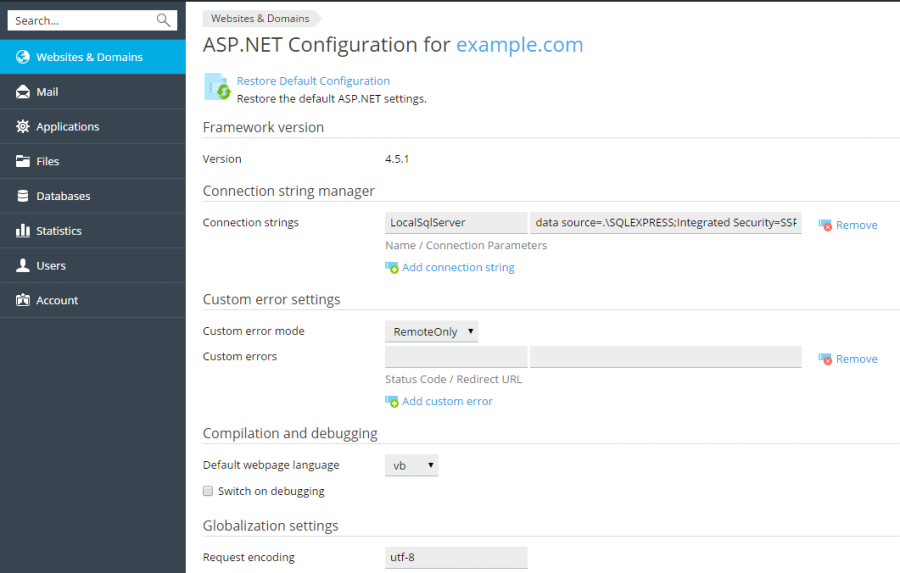
-
Fix the strings that determine database connection information for ASP.NET applications that use databases. This option is available but for ASP.Net 2.0.10.
When you open the ASP.NET configuration screen for the start time, sample connection parameters with common constructions are displayed. You can delete them and specify your own strings.
- To add a cord, click the Add connection string link and enter the required information into the Name and Connection Parameters input fields.
- To remove a string, click the Remove link next to it.
-
Set custom fault letters that will be returned by ASP.Internet applications in the Custom Error Settings field:
-
To prepare the custom fault messages mode, select an advisable selection from the Custom mistake way bill of fare:
- On - custom error messages are enabled.
- Off - custom error letters are disabled and detailed errors are to exist shown.
- RemoteOnly - custom mistake messages are displayed simply to remote clients, and ASP.Internet errors are shown to the local host users.
-
To add together a custom error message (which will be applied unless the Off mode was selected), enter the values in the Condition Code and Redirect URL fields, and click
 .
.- Status Code defines the HTTP status code resulting in redirection to the mistake page.
- Redirect URL defines the web address of the mistake folio presenting information near the mistake to the client.
Due to possible conflicts, you cannot add a custom error bulletin with an mistake code that already exists, but you tin redefine the URL for the existing code.
-
To remove a custom error bulletin from the list, click the Remove link next to it.
-
-
Configure compilation settings in the Compilation and Debugging field:
-
To decide the programming linguistic communication to be used every bit default in dynamic compilation files, cull an entry from Default web page linguistic communication listing.
-
To enable compiling retail binaries, leave the Switch on debugging checkbox empty.
-
To enable compiling debug binaries, select the Switch on debugging checkbox. In this case, the source lawmaking fragments containing fault will be shown in a diagnostic page bulletin.
Note: When running applications in debug mode, a retentiveness and performance overhead occur. It is recommended to employ debugging when testing an application and to disable information technology before deploying the awarding into production scenario.
-
-
Configure encoding settings for ASP.Net applications in the Globalization Settings section:
- To set an adopted encoding of all incoming requests, enter an encoding value into the Request encoding field (default is utf-8).
- To set an adopted encoding of all responses, enter an encoding value into the Response encoding field (default is utf-8).
- To set an encoding which must be used by default for parsing of
.aspx,.asmx, and.asaxfiles, enter an encoding value into the File encoding field (default is Windows-1252). - To set a culture which must be used by default for processing incoming web requests, select an appropriate item from the Culture list.
- To set a culture which must be used by default when processing searches for a locale-dependent resource, select an advisable item from the UI Civilization list.
-
Ready a code access security trust level for ASP.Cyberspace applications in the Code Access Security field.
CAS trust level is a security zone to which applications execution is assigned, defining what server resources the applications will have access to.
-
Enable the usage of the additional scripts in the Script Library Settings field. Specifying the script library settings is necessary if the validation web controls are used on your web site. This option is available but for ASP.Cyberspace one.one.x.
- If you need to use additional scripts (specifically, scripts implementing objects for validating input information), provide the settings for .Net framework script library. To do so, enter the path beginning with the domain root directory preceded by the forward slash into the Path to Microsoft script library field, or click the folder icon side by side to the Path to Microsoft script library field and browse for the required location.
- To initiate the car-installation of files containing the scripts to the specified location, select the Install checkbox. If the files already exist there, they will be rewritten.
-
Set up client session parameters in the Session Settings field:
- To prepare the default authentication manner for applications, select an appropriate detail from the Authentication mode listing. Windows hallmark mode should be selected if any class of IIS authentication is used.
- To fix time that a session tin can remain idle, blazon the number of minutes into the Session timeout box.
-
Click OK to use all changes.
 .
.mcintirelacir1946.blogspot.com
Source: https://docs.plesk.com/en-US/obsidian/customer-guide/websites-and-domains/hosting-settings/web-scripting-settings/aspnet-settings-windows.65283/
0 Response to "How to Upload Asp.net Website on Plesk Goddady"
Publicar un comentario