What Retail Cuts Can Come From a Beef Chuck
Cutting and Processing Meats
Primal, Sub-key, and Secondary Cuts
Beefiness
The beef animal is broken downward into sides. A side is one-half of a that has been dissever lengthwise from the neck to the tail. The side tin then be split into the front quarter and hind quarter. This cut is made betwixt the twelfth and 13th ribs counting from the front of the fauna. The beef front quarter is heavily exercised, resulting in an abundance of connective tissue. Moist oestrus cooking is required on the majority of the sub-primals from the front quarter, with the major exception existence the 7-bone rib (prime rib). The hind quarter of beefiness contains by and large sub-primals that can be prepared using dry heat.
Effigy 17 illustrates the cardinal, sub-primal, and retail cuts of beef.
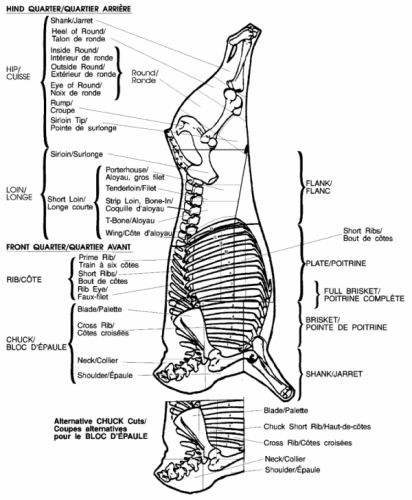
Beef Front Quarter: The beef forepart quarter contains four key cuts, the brisket, foreshank, rib, and chuck (square chuck). The chuck is separated by get-go cutting beyond the carcass between the 5th and 6th ribs, which separates the chuck, brisket, and shank from the rib and plate. The 2nd cutting passes at a point slightly above the elbow joint and through the cartilage below the first (1st) rib and sternum, and separates the chuck from the brisket and shank. The brisket is further separated from the shank past following the natural contour of the elbow bone. The rib is separated from the plate by a directly cut passing across the ribs at right angles to the first cut at a signal slightly beneath the centre of the rib muzzle.
The primals are and so candy into sub-primals by following the cutting lines as shown in Effigy 18 and Table 24.
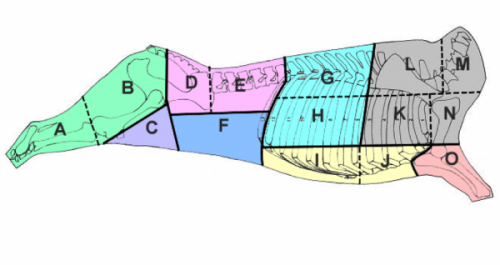
| Cardinal | Sub-Primal |
| Rib | Brusque rib (H) 7-bone rib (Grand) |
| Square chuck | Neck (Thousand) Bract (Fifty) Shoulder (N) Cross rib (K) |
| Brisket | Brisket point (J) Brisket plate (I) |
| Fore shank | No further break down required (O) |
From these sub-primals, farther usable portions are processed and retail cuts prepared for the consumer.
Beef Hind Quarter: The beef hind quarter is broken down into four primal cuts, the flank, the long loin, the hip, and the sirloin tip. The flank is separated by a directly cut passing approximately parallel to the lumbar backbone (lumbar vertebrae), beginning in shut proximity to or through the flank lymph node (prefemoral), and from the plate by a cut passing between the 12th and 13th ribs and cartilage. The hip is separated from the long loin past a straight cut that passes in front of the rump knuckle bone, thereby cutting the pelvic os into approximately two equal parts. The sirloin tip is then separated from the hip by a "V-shaped" cut beginning approximately at the knee cap, following the full length of the leg bone up to the rump knuckle bone, and so towards the flank lymph node.
The primals are then candy into sub-primals equally shown in Figure 18 and Table 25.
| Primal | Sub-Cardinal |
| Flank | No farther break downwardly required (F) |
| Long loin | Short loin (E) Sirloin butt (D) |
| Hip | Inside round (B) Outside round (B-opposite side of bone) Hind shank (A) |
| Sirloin tip | No farther break down (C) |
Breakdown of sub-primals into retail and wholesale cuts
From the sub-primals, secondary or portion cuts are obtained. In most cases, there are a number of dissimilar secondary cuts that can exist obtained from each sub-primal. In addition, there are often different names for the same cut used in the retail, wholesale, or restaurant industry. Table 26 shows the retail and restaurant cuts that come from each of the beefiness sub-primals.
| Sub-Central | Retail Meat Sales Cuts | Eating place Cuts | Alternating Names |
| Brusque rb | Curt ribs simmering (bone in or boneless) | Short ribs | |
| 7-bone rib | Prime rib over roast Standing rib oven roast | Prime rib | |
| Prime rib grillings steak | Rib steak | Côte de boeuf | |
| Ribeye grilling steak | Ribeye | Delmonico | |
| Beef ribs(cut from prime rib) | Finger bones | Beef back ribs | |
| Blade | Bottom blade | Chuckeye roll | |
| Height blade | Apartment iron | Mock tender | |
| Cantankerous rib | Cross rib (pot roast or marinating steak) | Short ribs, boneless short ribs | Chuck brusque rib |
| Beefiness ribs(cut from the cross rib) | Shoulder clod | ||
| Bolo | |||
| Deluxe 4-bone rib | |||
| Flat rib | |||
| Brisket point | Brisket pot roast | Corned beef | |
| Stew beefiness | |||
| Medium ground beefiness | |||
| Neck | Lean ground beefiness | ||
| Fore shank | Stew beef | Shin meat for consommé |
| Sub-Primal | Retail Meat Sales Cuts | Restaurant Cuts | Alternate Names |
| Flank | Flank marinating steak | Flank steak | |
| Flank steak London bake | |||
| Lean ground beefiness | |||
| Short loin | Porterhouse grilling steak | Porterhouse | |
| T-bone grilling steak | T-os | ||
| Fly grilling steak | Society steak | ||
| Tenderloin grilling steak | Filet, Fillet mignon, medallion | Tournedo, Chateaubriand, Mignonette | |
| Striploin grilling steak | New York | Top loin | |
| Sirloin butt | Acme sirloin (grilling steak and oven roast) | Sirloin steak | |
| Sirloin cap grilling steak | |||
| Bottom sirloin grilling steak | Tri tip | ||
| Tenderloin barrel grilling steak | Chateaubriand, fillet mignon | ||
| Inside round | Inside round over roast Inside circular marinating steak | Peak round | Businesswoman, top side |
| Outside round | Outside round over roast | Bottom circular | Gooseneck, silverside, exterior apartment |
| Exterior round marinating steak | Rouladen | ||
| Middle of round oven roast | |||
| Eye of round marinating steak | Swiss steak | ||
| Heel of circular (stew or ground) | |||
| Sirloin tip | Sirloin tip over roast | Peeled knuckle | |
| Sirloin tip marinating steak | Brawl tip | ||
| Round tip | |||
| Thick flank | |||
| Hind shank | Beefiness shank (crosscut) | Osso-bucco | |
| Stew beef | Shin meat for consommé | ||
| Lean basis beef |
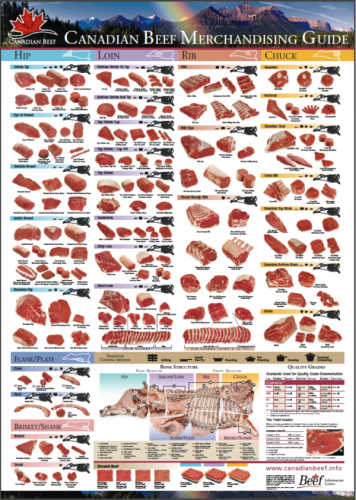
The Beef Information Heart provides a poster (Figure 19) that outlines the cuts of beefiness. It can be downloaded from their resource page.
The CFIA meat cuts transmission is an boosted resource that shows each beef cutting and location in groovy detail. It tin be accessed on the CFIA website.Table 26 shows the cooking potential for cuts from the different beef primals. Generally, the cuts from the same primal are suited for similar cooking methods. Exceptions accept been noted.
| Hind Quarter Primal | Cooking Potential | Notes (Exceptions) |
| Flank | Moist rut | The flank steak, which tin can be and cooked using dry heat |
| Long loin | Dry heat | |
| Hip | Dry oestrus | The hind shank and heel of circular, which have an abundance of collagen, making them ideal for stewing meat |
| Sirloin tip | Dry out heat | |
| Front end Quarter Primal | ||
| Rib | Dry out heat | |
| Foursquare chuck | Moist heat | Aside from one of the top bract muscles, which can have the heavy collagen removed and be portioned into flat iron steaks, which tin can be prepared using dry heat |
| Brisket | Moist heat | |
| Fore shank | Moist rut |
Veal
Musculus or flesh of a veal carcass ranges in color from pink (or lighter) to red. To be classified as veal by CFIA standards, the dressed carcass must counterbalance less than 180 kg (396 lb). Veal is most commonly sold in vacuum-packed sub-primals. It is seldom dry aged due to the lack of fat cover on the brute. Figure 20 shows the CFIA veal cuts.
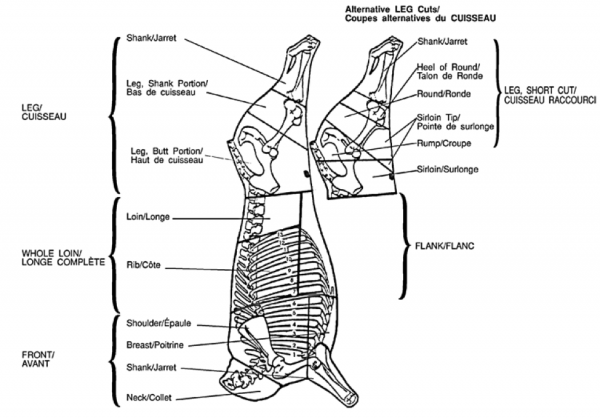
There are six primal cuts from a side of veal, the leg, flank, loin, breast, shoulder, and front shank. The front, containing the shoulder, breast, and front shank, is separated from the whole loin and flank past cutting between the 6th and 7th ribs. The chest and shank are further separated past a cut that goes from just above the articulation of the arm bone perpendicular to the ribs. The shank is and so separated by following the natural separation of the arm bone. The leg is separated from the whole loin and flank by a direct cut that passes in front of the pin bone. The flank is then separated from the whole loin by a straight cut approximately parallel to the courage, passing at a point slightly above the cartilage of the 12th rib.
The primals are further broken down into sub-primals equally shown in Figure 21 and Tabular array 28. Note that there are ii ways of cut the leg into sub-primals accustomed by CFIA.
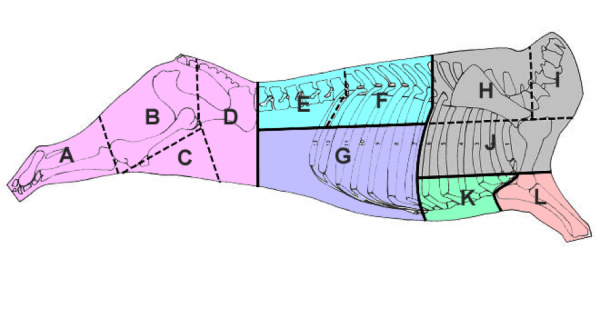
| Fundamental | Sub-cardinal |
| Veal leg | Leg cuts (sub-primal) and Alternative leg cuts (sub-primals) |
| Shank (A) and Shank (A) | |
| Leg, shank portion (B, portion of C) and Heel of round (bottom portion of B), Round (B) | |
| Leg, butt portion (D, portion of C) and Sirloin Tip (C), Rump (superlative portion of B), Sirloin (D) | |
| Veal flank | No further breakup (M) |
| Veal loin | Loin (Eastward) |
| Rib (or rack) (F) | |
| Veal shoulder | Shoulder arm (J) |
| Shoulder blade (H) | |
| Neck (I) | |
| Veal chest | No further breakdown (Grand) |
| Veal front shank | No farther breakdown (50) |
The sub-primals are cut further into retail or restaurant cuts every bit shown in Table 29.
| Primal | Sub-Central | Retail Meat Sales Cuts | Restaurant Cuts | Alternate Names |
| Veal leg | Shank | Veal shank crosscut | Osso-bucco | |
| Leg, barrel portion | Veal inside round | Cutlets, | Veal peak round | |
| Veal outside round | Veal bottom round | |||
| Veal leg cutlets (breaded) | Schnitzel | |||
| Sirloin tip | Veal sirloin tip | Veal knuckle | ||
| Sirloin | Veal tiptop sirloin | Veal hip | ||
| Veal flank | Ground, sausage | Ground veal | ||
| Veal loin | Loin | Veal loin roast | Veal strip loin | Saddle |
| Veal loin chops | Veal T-os | |||
| Veal tenderloin | Veal tenderloin, medallions | |||
| Rib | Veal rib chops | Veal chop | ||
| Veal rib roast | Veal rack | Hotel rack | ||
| Veal shoulder | Veal shoulder arm | Shoulder roast, chops | Square chuck | |
| Veal shoulder blade | Cubed veal, footing veal | |||
| Veal breast | Veal breast, rolled, blimp | Breast of veal, cubed veal, ground veal | Brisket | |
| Veal front shank | Veal shank crosscut | Osso-bucco |
The Veal Farmers of Ontario provide a comprehensive veal cutting chart (Figure 22) for download.
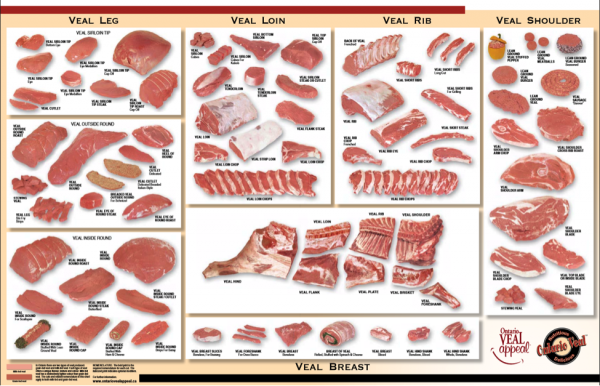
The CFIA meat cuts manual is an additional resource that shows each veal cut and location in great detail. It can be accessed on the CFIA website.
mcintirelacir1946.blogspot.com
Source: https://opentextbc.ca/meatcutting/chapter/primal-sub-primal-and-secondary-cuts/
0 Response to "What Retail Cuts Can Come From a Beef Chuck"
Publicar un comentario